SPECIES DESCRIPTION
LIMONIUM CRATERIFORME
Family and Genus:- See- PLUMBAGINACEAE
Common Names:- None
Synonyms:- None
Meaning:- Limonium (Gr) Meadow-plant. A name used by the Greek physician
and botanist Dioscorides.
Crateriforme (L) Refers to the shape of the glands found on plants of
this species.
Description:- Plant perennial, glabrous, forming a sub-shrub 15-55 cm tall, with
several ascending to erect stems and a robust tap-root.
Caudices:-
1) 5-15 cm long, branched, densely spirally leafy in the upper half; living leaves at
the apices in rosettes.
Stems:-
1) 13-50 cm long, flexuous, constricted at the nodes, conspicuously tuberculate
with many crateriform glands, branching begins near the base of the stems;
normally repeatedly proliferating in the axes.
Leaves:-
1) 8-40 mm x 1.5-5.0 mm, fleshy, grey-green to glaucous, flat or v-shaped in cross-
section, tuberculate with many crateriform glands, narrowly spathulate to
narrowly oblanceolate, apex acute to rounded, retuse, with one central nerve,
gradually tapering into the petiole.
Flower:-
1) Inflorescence, trullate or obtrullate in outline.
2) Branches:
a) sterile, numerous, 1-10 cm long, straight to curved, constricted at the nodes,
undivided or branched.
b) fertile, 2-25 cm long, conspicuously tuberculate with many crateriform glands,
flexuous, articulate, long branches arched,
c) short, straight, directed obliquely upwards or nearly spreading, forming
branching angles of 20°- 70°, branched.
3) Spikes, 20-130 mm long, straight to arched, directed obliquely upwards; axis of
the spike with many crateriform glands.
a) spikelets 9.0-10.5 mm long, composed of 1-4 flowers, very remotely arranged
with 1-4 per 2 cm.
4) Bracts:
a) outer, 2.8-3.8 mm x 2.1-3.0 mm, triangular-ovate, acute to obtuse, margin
broadly membranous; central part fleshy, with several crateriform glands,
acuminate.
b) middle, membranous, 3.0-4.0 mm x 2.0-2.7 mm, obovate-elliptic to oblong-
obovate, rounded.
c) inner, 8.2-9.8 mm long and 4.0-5.2 mm broad, oblong-obovate, rounded,
margin
broadly membranous; central part fleshy, with many crateriform glands,
6.0-7.8 x mm x 2.9-4.3 mm,, oblong-obovate, acuminate, forming a narrowly
triangular tip, 1.0-1.5 mm long, not reaching the upper margin.
5) Calyx, often slender, 6.0-7.2 mm long, exceeding the inner bract by 1.0-1.5 mm;
a) tube, glabrous, with 5 ribs ending above the base of the lobes;
b) lobes, ca. 0.7 × 0.9 mm, semi-elliptic; sometimes the margin of the calyx
after anthesis.
6) Corolla lilac.
Fruit:-
1) Dry, membranous, 1-seeded, surrounded by the calyx, not splitting indehiscent
or with circumscissile or irregular dehiscence.
Key features:-
1) Leaves, 8-40 × 1.5-5.0 mm, narrowly spathulate to narrowly oblanceolate,
1-nerved,
2) Stems, many, conspicuously tuberculate, proliferous,
3) Spikes, 20-130 mm long,
4) Spikelets, 9.0-10.5 mm long, 1-4-flowered, arranged 1-4 in 2 centimeters,
5) Lower bract, 2.8-3.8 × 2.1-3.0 mm, triangular-ovate,
6) Middle bract, 3.0-4.0 × 2.0-2.7 mm,
7) Upper bract, 8.2-9.8 × 4.0-5.2 mm, oblong-obovate, margin broadly membranous,
8) Calyx 6.0-7.2 mm long, from upper bract 1.0-1.5 mm exserto, tube glabrous,
a) lobes, ca. 0.7 × 0.9 mm, semi-elliptic, sometimes margins of the lobes
lacerated after anthesis
Habitat:- Rocky coast on various substrates.
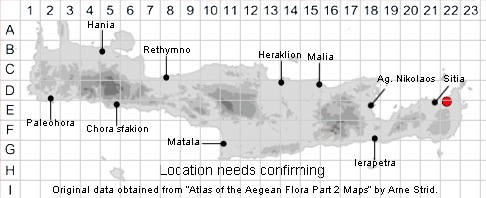
Distribution:- Widespread on Karpathos and Kasos; very rare in northeastern Crete
Taxonomic remarks:-The occurrence of numerous crateriform glands covering the
whole plant, its glaucous stems with numerous sterile branches, and the remotely
arranged spikelets indicate that L. crateriforme is closely related to L. proliferum and
L. stenotatum. However, it may be differentiated from both species mostly by having
longer outer and inner bracts.
Flowering time:-
Photos by:- Currently unavailable